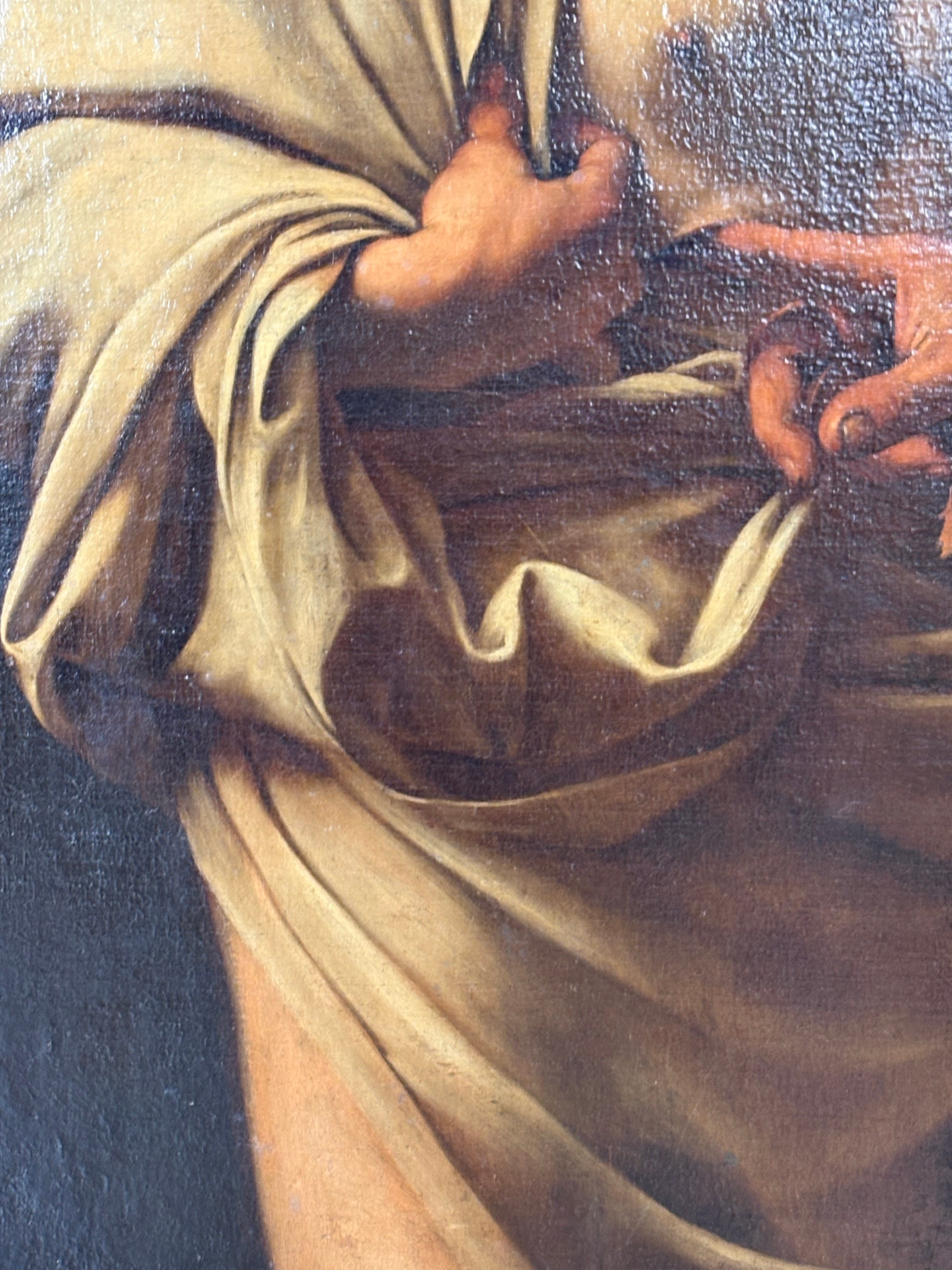
Throughout my life, I have found myself being called by objects. Art has said hello to me since I was four. Other times, it is nature. Have you ever heard a piece of art speak to you? The first painting to speak to me through a book was Caravaggio’s Incredulity of St Thomas. To be honest, for years I did not understand what incredulity means. The title changes depending on what language is translating. It means disbelief. The painting depicts Jesus post Resurrection, the time he comes back from the dead, and he is making good on his promise to check in with his friends. Thomas, also known as Doubting Thomas, and my own middle name, is seen as the fulcrum character in this painting. The disbelief of Saint Thomas, an apostle of Jesus, is seen pulling up the skin of Jesus’ wound. It has captured my imagination ever since I saw it in that book.
I see Caravaggio as the Stephen Spielberg of painting. I often get self conscious of some of my favorite paintings, movies, or operas. Because I love Jaws (Spielberg), Turandot (Puccini), and I love Caravaggio. These are often seen as creations for the masses, or art for “the people.” One might say these are easier to access and because they are enjoyable for some very basic reasons, then the work itself is not to be enjoyed or bring pleasure. Or for that matter, one who likes these must not have any taste. I to tend to disagree with this approach. They are masterworks works for a reason.
I love this painting. When I was living a double life, one life to make my mother proud, and the other one that might bring shame, even to you. I don’t mean to be vague about this double life. Well, actually, I do. What I love about Caravaggio’s painting here, it is not vague. My achilles growing up was always not being believed. A fact, something about whales or dolphins. And when it got more serious, the same ignoring. My story of abuse and double life when I have often shared, the first response is doubt. Not to compare myself to Christ in the painting, but I have often felt like the open wound in Christ’s side. This wound was made by the soldiers as an afterthought to make sure Jesus was dead on the cross. And maybe one day, through my one man show, I can show you the wound like Jesus shows Thomas. The wound is unnecessary, forgotten in much of artists portrayl of Christ on the cross, and not central to the story. Yet, Caravaggio here makes the wound the focal point. Even when I saw it in the book as a high schooler, I couldn’t help but look at the fold of the skin and figure. It is erotic to me. Some are disgusted. Some maybe be comforted. It shouts, “this IS Jesus.” Believe!
Being raised Catholic, this visualisation of a story of my namesake, I became obsessed with the idea one could doubt their faith in God and therefore, Jesus. I photo copied it. I carried it around. Like a prayer card. I had to remind myself that doubt in oneself, is central to faith. Nowadays, I don’t believe Jesus rose from the dead. But, this painting captured the feeling of walking around with a wound that I thought everyone could see. Jesus has to pull down his shroud that the women wrapped him in. And his thigh peeking out in the bottom left corner. This is a salacious picture. And each of us have wounds in our side that we can’t see. What a dramatic moment captured by a painter. Ever since that photo copied version, I told myself I would find this painting and visit it.
Seeing my first Caravaggio canvas (arguably there are as low as 40 and as many as 80 pictures around the world) was about 10 years ago at The Met. This picture of Saint Thomas is located in Potsdam, Germany at Frederich the Great’s palace. He housed his collection in a separate picture room. On my recent trip to Berlin, I was with my dear friend Michael from San Francisco. I had told him the effort that it might take and he was amenable. This painting was my goal. To access Potsdam, one must take the train from city centre of Berlin, on the same railroad most Jews were taken out of the city. We passed a station, the Platform 17 Memorial at Grunewald Station, which commemorates the thousands of Jews who were deported from Berlin. Jews, Catholics, homosexuals, gypsies and other minorities departed to concentration camps on the same railway as I was on. It is possible for me to not write this sentence, but there is no way I could erase that feeling of being on the train headed out of the central hub of Berlin into the unknown woods. To not channel that minority feeling. Well, its impossible for me to ignore it. I would have been sent to the camps. My friend Michael, too. Thomas, too, was an outsider as an apostle who doubted Jesus. The station has preserved as part gardens and list names of the victim on the train platform. I was looking for Thomas.
At the Potsdam train station, we transferred to a bus. While waiting for the bus, I had to pay for the bathroom. I realized it was the first time I ever had to pay for the bathroom. It made me think about all the times I have needed to go to the bathroom and couldn’t. Isn’t that a horrible feeling we have designed in society. It got me to think about being an apostle and being uncomfortable and uneasy about waiting for Jesus to return. He did promise he would return. How unrealistic, how scary, how unnerving. It kind of has that “I have to go to the bathroom and can’t find a bathroom” feeling. We then waited for a bus with other tourists. I often forget that some of my pilgrimages are other people’s checklist. Does intention matter when doing a self imposed pilgrimage? No one cares that I have been staring at this painting for 20 plus years in a book or on the internet. I am just another tourist, another ticket, another voyeur to gawk at inherited wealth.
I did wonder to myself that I might be disappointed by the painting itself. Why build up so much expectation for one painting? I don’t know. I don’t have an answer to those who don’t connect to painting. I often give myself permission to connect in a deep way without knowing the full story. It is just a painting. But, the story of faith and Thomas looms large in my life. I wasn’t named for anyone specifically. My Mom just liked the sound of the names together. All I get from is that it is too many syllables for most people “Gregory Thomas.” Five to be exact. A pope and an apostle. I measured my name in Catholic figures. Thomas is originally a male name of Aramaic origins meaning ‘twin’. And the Greek meaning is also ‘twin’. Twin of doubt? Double life. All possible.
And then, finally, I was standing in front of it in this great hall of pictures from Renaissance to Baroque masterworks.
After twenty-something years of reproductions, photocopies, computer screens, art books, and my own private myth I had built around this painting, there it was. Much smaller than the space it had occupied in my imagination and surrounded by other pictures. European pictures rooms feel like the Doom Scroll of Art History sometimes, overwhelming and difficult to focus.
I looked immediately at the wound. Of course I did.
Thomas’s finger is still there, pressing into Christ’s side. The other apostles crowd around him. Nobody is calm, there is lots of anxiety in this picture. Nobody seems particularly “holy.” They look curious, confused, almost embarrassingly human. Caravaggio doesn’t give Thomas faith. He gives him cold hard evidence.
For most of my life, I think that is what I wanted too.
Evidence. A list of facts. A sense of rightness.
Something I could point to and say: See? It happened. Look here. Put your finger here if you have to. Believe me.
Maybe that is why I carried this painting around when I was young. I thought Thomas was the doubter. I am less sure now. Maybe I was Thomas. Maybe I was Christ. Maybe I was the wound itself, waiting for somebody to notice me.
Or maybe none of us stay in one role very long.
I stood there longer than I needed to. I had come all this way. I sat down on the marble floor in front of it trying to get a photo without the glare of the high afternoon sun. The picture was seemingly impossible to capture it. Even in front of it, the true painting alluded me. European galleries are so rich with paintings, that they forget to light them properly.
That may be the strange thing about a self-designed pilgrimage. I travel thousands of miles toward something believing that when I arrive, it will reveal itself to me. Instead, I arrived and discovered that the object hasn’t changed at all. Thankfully, its protected and well kept and doesn’t move. I can trust that. And yet, something else deeper moved inside me. I had been the one who has changed.
I don’t believe Jesus rose from the dead anymore. I don’t know that I need to. But I still believe in Thomas reaching toward the wound. I believe in his doubt. I believe in the strange intimacy of needing to touch something before I can understand it. And I respect faith in mystery.
Increasingly, I believe the wound exists to teach me and make me who I am, whether anyone believes me or not.
Twenty years ago, I photocopied a painting into my brain because I needed to carry it with me.
In Potsdam, I finally got to put it down. Check.